
INTRODUCTION

Common Name:Crystal Jellyfish

Sientific Name: Aequorea victoria

ANATOMY:
Oral- The side of the body that contains the mouth.


Aboral- The exumbrella or outside of the bell. Opposite the mouth.


Bell- The body of the Jellyfish; in the shape of the bowl.

Manubrium- A long tubular process that hangs into the subumbrellar
 space below the bell. At the tip we find the mouth.

Stomach- The digestive region of the coelenteron. Extracellular
digestion occurs here.

Radial Canals- 4 radial canals extend from the stomach into the bell
 margin.

Gonad- Sexual reproductive organs, may be found on the manubrium or
 on the radial canals.

Velum- Is a thin circumferential shelf of tissue that encircles the
subumbrellar cavity. It's also a defining characteristic in
hydromedusae.

Tentacles- Arise from the outer margin are used in attaching to sea
grasses and weeds. Also used to capture prey.

Locomotion:
victoria, a paddling victoria, a paddling type hydromedusa, is found
to draw fluid from the upper bell surface and eject this fluid in
pairs of counter-rotating, slow-moving vortices near the bell margins.

Diet:
They mainly eat soft-bodied organisms.
Crystal jellies can expand their mouth to eat prey half their size.
The crystal jelly eats planktonic creatures, comb jellies, and other jellyfish.
They feed off on mammals in the ocean also.
\They occasionally eat fish that are up to half their size, it is more common to see them feeding on soft-bodied organisms.
The jellyfish has venom in its tentacles so the fish in the picture above would have first been injected with venom using the sticky end of the tentacles.
 Habitat:
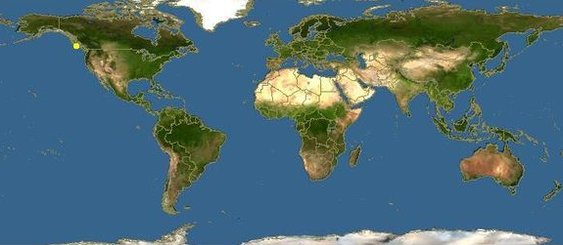
found off the west coast of the United States and Canada.
inhabit from central California up to Vancouver with the largest
concentration residing around Washington and British Columbia
The yellow dot represents where the jellyfish are located in the
greatest concentration. It is at this yellow dot that British
columbia is located.
Habitat:
found off the west coast of the United States and Canada.
inhabit from central California up to Vancouver with the largest
concentration residing around Washington and British Columbia
The yellow dot represents where the jellyfish are located in the
greatest concentration. It is at this yellow dot that British
columbia is located.
 Life cycle: several different stages.
adult/medusa stage: they can reproduce sexually by releasing sperm
and eggs into the water, forming a planula.
In this stage of jellyfish life, the planula hooks on to the bottom
of a smooth rock or other structure and grows into
another stage of jellyfish life, the polyp--which resembles a
miniature sea anemone.
During this stage, which can last for several months or years,
asexual reproduction occurs. The polyps clone themselves and bud,
or strobilate, into another stage of jellyfish life, called ephyra.
It is this form that grows into the adult medusa jellyfish.
Behaviors:Jellyfish do not attack humans but some will sting if they
come into contact with one. The severity of the sting depends on a
few things, including the species of the jellyfish and the
sensitivity of the person to its venom. Most cases are minor, but
some have been known to be fatal.
Defense:
Life cycle: several different stages.
adult/medusa stage: they can reproduce sexually by releasing sperm
and eggs into the water, forming a planula.
In this stage of jellyfish life, the planula hooks on to the bottom
of a smooth rock or other structure and grows into
another stage of jellyfish life, the polyp--which resembles a
miniature sea anemone.
During this stage, which can last for several months or years,
asexual reproduction occurs. The polyps clone themselves and bud,
or strobilate, into another stage of jellyfish life, called ephyra.
It is this form that grows into the adult medusa jellyfish.
Behaviors:Jellyfish do not attack humans but some will sting if they
come into contact with one. The severity of the sting depends on a
few things, including the species of the jellyfish and the
sensitivity of the person to its venom. Most cases are minor, but
some have been known to be fatal.
Defense:

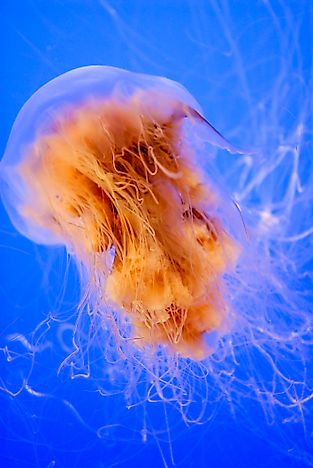 Enemies:other vicious jellies such as the Lions Mane Jellyfish and
others.
Enemies:other vicious jellies such as the Lions Mane Jellyfish and
others.
 Something Special: They help protect small fish by allowing them to
hide next to their body and by stinging the predators after them.
Something Special: They help protect small fish by allowing them to
 hide next to their body and by stinging the predators after them.

Kingdom:Animalia
Phylum: Cnidaria
Class: Hydrozoa
Order: Leptothecata
Family: Aequoreidae
Genus: Aequorea
Species: victoria
 Seaxsplore